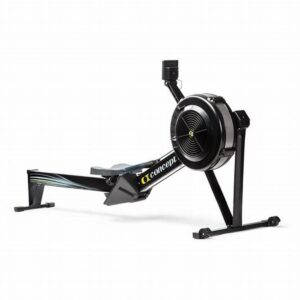
NRG Regatta™ Indoor Rowing Machine
Designed and built to the highest standards to offers an unparalleled quality rowing experience. With its water-resistance system, this fluid rower closely emulates the feel and sound of rowing on the water. This rower provides far smoother and quieter action than wind resistance rowers. This is due to the sturdy and durable aluminium frame that house our highly effective water paddle flywheel system in the leakproof water tank

Features:
Durable aluminium frame design offers a Stylish contemporary feel that harmonize in any environment
Leakproof water tank that emulates the feel of rowing on water
Total Body workout for strength and Cardiovascular exercise for all fitness levels
Quiet when operating with smooth and consistent resistance through strokes
Sturdy and built to last with a Maximum User Weight Limit of 150KG
Low maintenance: replace water occasionally
Total Body Workout
Paddling motion with uniform resistance, which can distribute the workout load more evenly across the muscle groups, training in proportion to the strength of the muscle group. With
How to use the Water rower
The rowing action will use 84% of your muscles: from the fingers holding the handle to the base of the toes and feet that are in contact with the pedal assembly/hull. All the muscle groups between these two parts that are in contact with the water rower are involved in the rowing action.
The rowing action consists of two phases: one fast (advance) and one slow (reset). Rowing skills also require the integration of these two actions into a rhythm for smooth and unrestrained motion.
Three basic rowing actions:
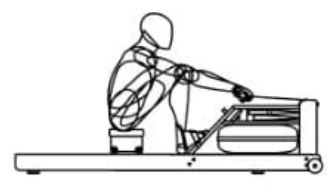
Grip posture
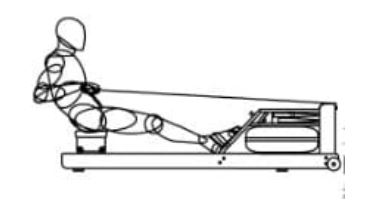
The back is straight and steady, the arms are straight and forward, the shoulders are relaxed, looking up straight ahead, the thighs are tightened, and the feet are perpendicular to the ground.
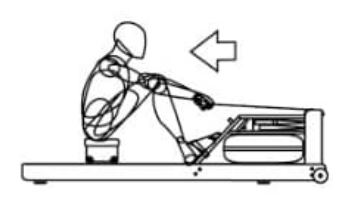
Water entering stage
The legs work in sync with the arms and pull the handle backwards. Only when the handle is over the knee, the body trunk is fully stressed, and the body and the legs are opened at an angle, the body is ready to be reset.
Training stage
Straighten your legs, pull handle to your chest, sit back more than 90 degrees, tighten your torso, relax your shoulders, and look up straight ahead.
In the beginning, please arrange to practice the correct movements and the frequency and rhythm of rowing. Based on the standard rowing action, the rowing skill is easier to improve, and the physiological benefits of rowing can be also felt more quickly.
Display:
1.SPM:range from0~999。
2.TIME:range from 0:00~99:59,can count up and count down.
3.DISTANCE:0~9999 K / M, can count up and count down.
4.CALORIES:range from 0~9999,can count up and count down.
5.PULSE:P~30~230。
6.Manual:general mode
7.INTERVAL:intermittent resting exercise mode.
8.TARGET:target control mode.
9. METER/MILE
10. TIME/500: Every 500 meters will be automatically displayed and constantly updated
Aerobic training
A long-lasting training program improves the oxygen supply efficiency of the respiratory and cardiovascular systems, such as improving lung function, heart function, vascular efficiency, and capillary growth, thereby improving the health and endurance of the body. At a maximum heart rate of 70-80%, lactic acid begins to accumulate in the blood at a rate that is too large to be discharged through organs such as the liver and kidneys. Therefore, when the exercise intensity is higher than the maximum heart rate of 70-80%, it may cause more and more lactic acid to accumulate in the blood, increase heart rate and respiration, and cause muscle fatigue. Prolonging the exercise time at or below 70-80% of the maximum heart rate maintains lactic acid at a level of muscle non-fatigue, and the duration of exercise is limited to consuming the available body energy. If your exercise goal is aerobic training (cardiovascular/endurance), then your exercise intensity should avoid fatigue caused by lactic acid buildup. It is best achieved by medium exercise intensity plus medium or longer exercise time. Steady jogging is a moderate-intensity (70-80% maximum heart rate) exercise that avoids muscle soreness. Always consult a physician before taking on any new exercise.
Anaerobic training
Exercise at anaerobic intensity can give athletes fatigue resistance, but this benefit is only psychological rather than physiological. Extending exercise time at high intensity will not only reduce weight but also damage the effect of aerobic training. At the same time, rapid fatigue has also led to an inability to improve exercise technology and increases the risk of injury.
Anaerobic training (80-100% of maximum heart rate) is usually performed under high intensity and for a short time (10-60 seconds). Interval training is an anaerobic training.